October 6, 2026
How to Get the Most Out of Custom 3D Printing | Emerald Layer
Learn how to order custom 3D prints with confidence. Tips on measurements, photos, materials, and design from Emerald Layer 3D Printing in Humboldt County.
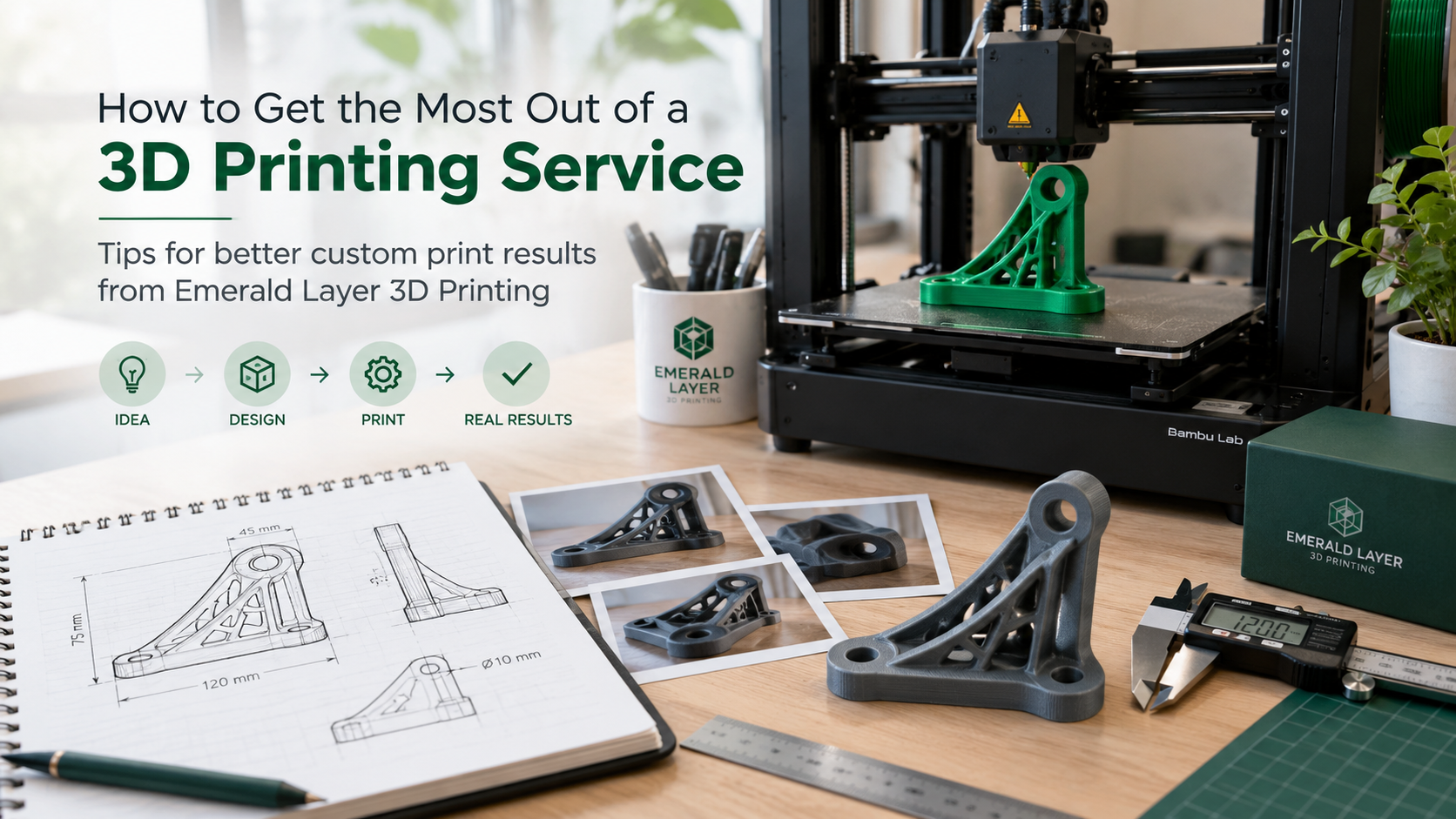
How to Get the Most Out of a Custom 3D Printing Service: 9 Tips for Bringing Your Ideas to Life
Have an idea for something you'd like to have 3D printed but aren't sure where to start? You're not alone.
One of the greatest things about modern 3D printing technology is that you no longer need to own expensive equipment, understand complicated design software, or have a background in engineering to bring an idea into the physical world.
Whether you're looking to replace a broken plastic component, create a personalized gift, develop a product prototype, or turn a completely original idea into something you can hold in your hands, a custom 3D printing service can help make it happen.
But there's something many first-time customers don't realize: the information you provide at the beginning of your project can make an enormous difference in the final result.
At Emerald Layer 3D Printing, located in McKinleyville, California, we believe custom manufacturing should be accessible to everyone, not just engineers and professional designers.
That's why we've put together this guide to help you understand how to get the most out of a custom 3D printing service.
Let's get started!
- Start With a Clear Description of Your Idea
You don't need to know anything about 3D modeling to get started. You just need to be able to explain what you're trying to accomplish.
When reaching out to a 3D printing service, begin by describing what you want to create and, more importantly, what you want it to do.
For example, instead of simply saying:
"I need a plastic bracket."
Try something like:
"I need a small plastic bracket that mounts underneath a shelf and holds a flashlight. It needs to attach with two screws and securely hold the flashlight while still allowing me to remove it easily."
See the difference?
The second description provides valuable information about the object's purpose, how it will be used, and what features the finished design might require.
Pro tip: Don't worry about using technical terminology. Explain your idea in your own words, just like you would to a friend.
A good 3D printing service can help translate your ideas into something that can actually be manufactured.
- Pictures, Sketches, and Drawings Are Extremely Helpful
You've probably heard the expression, "A picture is worth a thousand words."
When it comes to custom 3D printing, that couldn't be more accurate.
Providing visual references is one of the easiest ways to help a 3D printing service understand exactly what you're looking for.
And here's the best part: Your drawings don't have to be professional.
A simple sketch on a piece of notebook paper can communicate important details that might otherwise be difficult to describe.
Some helpful visual references include:
- Photographs of an existing object you'd like to reproduce or modify.
- Hand-drawn sketches showing the general shape and layout.
- Pictures of similar products that demonstrate the style you're imagining.
- Screenshots or online images showing specific features you'd like incorporated.
- Photos of the area where your finished part will be installed.
For example, if you need a custom replacement part for something around your house, taking several pictures of the original component and where it connects can provide an excellent starting point.
Whenever possible, photograph the object from multiple angles.
Front, back, side, and top views can help communicate its overall geometry.
Remember: We aren't judging your artistic abilities. A rough sketch with a few measurements can be far more useful than a beautiful picture that doesn't explain how something works.
One important distinction: photographs help communicate a design, but they don't automatically provide the exact dimensions needed to reproduce it accurately.
That brings us to our next tip.
- Measurements Matter More Than You Might Think
One of the biggest advantages of 3D printing is the ability to create objects with highly specific dimensions.
But to take advantage of that precision, accurate measurements are essential.
If you're requesting something decorative, approximate dimensions might be perfectly acceptable.
However, if you're creating a replacement component, mechanical fitting, or anything that needs to connect to another object, even small measurement differences can affect whether the final product works correctly.
Try to provide measurements such as the object's overall length, width, and height, along with the locations and sizes of any important holes, openings, or connection points.
Millimeters are especially useful in 3D printing, although inches work too.
For parts that need to fit together, it's also helpful to explain whether the connection should be tight, loose, removable, or permanent.
For example, a bracket that slides onto a metal rail may require a small amount of clearance to fit properly.
The exact clearance depends on the design, material, printer, and intended use.
Pro tip: If you're measuring an existing object, a digital caliper can be incredibly helpful for capturing dimensions more accurately than a standard tape measure.
Don't have one? That's okay. Provide the best measurements you can, and explain which dimensions are estimates.
- Explain How the Finished Product Will Be Used
This is one of the most overlooked steps when ordering a custom 3D print.
Two objects that look almost identical may need to be designed and printed very differently depending on their intended purpose.
Think about the difference between a decorative display piece and a functional component that needs to support weight.
A decorative object may prioritize appearance and surface quality.
A functional component may require additional consideration for strength, flexibility, durability, and how forces will affect the part during use.
When describing your project, consider questions like:
Will the object be used indoors or outdoors?
Will it need to support weight or experience repeated stress?
Will it be exposed to sunlight, moisture, or elevated temperatures?
Does it need to flex, snap together, or connect with other components?
These details help determine whether the proposed design and available printing materials are appropriate for the job.
For example, PLA is a popular 3D printing material that works well for many decorative pieces, prototypes, and everyday applications.
However, PLA can soften or deform when exposed to elevated temperatures, making it unsuitable for certain applications.
Understanding the intended use before printing helps identify these limitations early.
The goal isn't simply to create something that looks right. It's to create something that works for its intended purpose.
- Have an Idea of Your Preferred Size, Color, and Appearance
Custom 3D printing offers tremendous creative freedom, but a few decisions about appearance can help narrow down your options.
Consider the overall look you're hoping to achieve.
Are you imagining a smooth, minimalist design? Something bold and colorful? A detailed decorative piece?
Is the object meant to blend into its surroundings or stand out as a centerpiece?
If you have a particular color in mind, mention it when requesting your project.
It's also helpful to understand that different 3D printing processes and materials produce different finishes.
With common filament-based 3D printing, objects are created by depositing material one layer at a time.
As a result, subtle layer lines may be visible on the finished surface.
These lines are a normal characteristic of the manufacturing process, although their appearance can vary significantly depending on the print settings, geometry, and material.
If your project has specific aesthetic requirements, communicate those expectations before production begins.
- Share Your Budget and Timeline Up Front
Custom 3D printing projects can vary significantly in complexity.
A small, straightforward item printed from an existing digital model may require relatively little preparation.
A completely original product, on the other hand, could involve design work, adjustments, test prints, and additional finishing.
Several factors can influence the cost of a project, including its size, material requirements, print duration, complexity, and the amount of design work needed.
If you have a specific budget, don't hesitate to mention it.
For example:
"I'm hoping to keep this project under $50. Is there a way to simplify the design to make that possible?"
Sharing your budget allows the printing service to help you evaluate potential options without wasting time pursuing a design that may not fit your expectations.
The same principle applies to deadlines.
If you're ordering a personalized gift for a birthday or need a prototype ready before an important meeting, communicate that information as early as possible.
Production timelines depend on the project's complexity, design requirements, and current workload.
Being upfront about your budget and timeline helps everyone work toward a realistic solution.
- If You Already Have a 3D Model, Send It!
Not every custom 3D printing project needs to begin from scratch.
Thousands of digital 3D models are available online, and many people create their own designs using software such as Fusion, Blender, or Tinkercad.
If you already have a digital model, providing that file can make the process much easier.
Common file formats used in 3D printing include STL and 3MF, while formats such as STEP can be useful when a design needs to be reviewed or modified.
However, there's an important detail worth understanding.
Just because a model looks good on a computer screen doesn't necessarily mean it's ready to be 3D printed.
Some models contain geometry that can't be manufactured successfully without modifications.
Others may have extremely thin sections, unsupported features, or dimensions that don't translate well into a physical object.
A printing service can review a model to determine whether it's suitable for its intended printing process and identify potential concerns.
Also, if you've downloaded a model online, make sure you have permission to use it for your intended purpose. Some designers allow personal printing but prohibit commercial use.
- Be Open to Suggestions and Design Improvements
One of the advantages of working with a custom 3D printing service is having another set of eyes on your project.
Sometimes the idea you originally imagined can be improved through relatively simple changes.
Maybe a component could be made stronger by adjusting its shape.
Perhaps a large object could be divided into multiple pieces for easier manufacturing.
A complicated design feature might be simplified without sacrificing functionality.
Or a small dimensional adjustment could make the finished product easier to assemble.
This collaborative process can be especially valuable when developing original products and functional prototypes.
The first version of an idea doesn't always have to be the final version.
In fact, one of 3D printing's greatest strengths is the ability to create prototypes, evaluate them, make adjustments, and produce improved versions without investing in expensive manufacturing molds.
Don't be afraid to ask questions or discuss alternative approaches. The objective is to find the best practical solution for your project.
- Understand That Prototyping Is Part of the Process
This final tip is especially important for anyone developing an original invention, replacement component, or functional product.
Sometimes a design looks perfect on paper but behaves differently once it becomes a physical object.
A connection might be slightly too tight.
A moving component might need more clearance.
An item might feel uncomfortable to hold, or a mounting feature may need to be repositioned.
These discoveries aren't necessarily failures.
They're valuable information that can help improve the next version.
This is exactly why 3D printing has become such a powerful tool for product development.
Instead of committing to large production quantities immediately, you can often begin with a single prototype.
That prototype can then be evaluated, tested, and refined before producing additional units.
For functional designs, this process can help uncover potential issues while changes are still relatively inexpensive.
Keep in mind that prototypes should be tested appropriately for their intended applications. A successful print alone doesn't establish that a part is safe for critical structural, electrical, medical, or other high-risk uses.
For inventors, entrepreneurs, and everyday problem-solvers, the ability to move from an idea to a physical prototype is one of the most exciting opportunities that modern 3D printing provides.
You Don't Need to Be an Engineer to Bring Your Ideas to Life
Perhaps the biggest misconception about custom 3D printing is that it's only useful for engineers, designers, or people who already understand the technology.
That simply isn't true.
Some of the most interesting applications come from everyday people who recognize a problem and imagine a better solution.
Maybe you need a replacement part that the manufacturer no longer sells.
Perhaps you've imagined a unique accessory for your home, vehicle, workshop, or hobby.
You might be developing a product you eventually hope to sell.
Or maybe you just want to create something completely original.
Whatever your idea might be, the first step doesn't have to be complicated.
Start with a description. Share a few pictures. Include whatever measurements you have. Explain what you're hoping to accomplish.
From there, you can begin exploring what it would take to turn your idea into reality.
Custom 3D Printing in Humboldt County, California
At Emerald Layer 3D Printing, we're passionate about making modern manufacturing technology more accessible to our community.
Based in McKinleyville, California, we serve customers throughout Humboldt County and beyond.
We believe you shouldn't need a factory, specialized equipment, or an engineering degree to explore the possibilities of custom manufacturing.
Whether you're interested in personalized creations, functional accessories, replacement components, or bringing an original concept to life, we're always interested in hearing about new project ideas.
And if you're not sure whether something can be 3D printed, that's a perfectly good reason to reach out and ask.
Have an Idea? Let's Talk About It!
Your next great idea might be just one conversation away from becoming something real.
Visit EmeraldLayer.com to explore our work and get in touch about your custom 3D printing project.
Tell us what you're imagining, send over any pictures or drawings you have, and let's explore what's possible.
Emerald Layer 3D Printing
Custom 3D Printing | McKinleyville, California
Proudly Located in Humboldt County